Where Tai Chi Comes From
Tai chi was born in China, in Chen Village, in the 1600s — a martial art built on Taoist philosophy, the balance of yin and yang. In the 1800s, Yang Luchan shaped it into the flowing Yang style most people practice today: slow, continuous movements that look gentle and feel like a full-body workout once you're in them.
It traveled from village courtyards to parks across the world because it works for everybody — warriors, grandparents, athletes recovering from injury. You don't need to be flexible. You don't need to be fit. You just start moving.
Why Warriors Practice It
- Balance that saves you. Slow weight shifts train the small stabilizer muscles that keep you upright — on the mat and on the job.
- Joints that move freely. Every posture flows through a full range of motion without impact, easing stiff hips, knees, and shoulders.
- Legs of iron, quietly. Those deep stances build serious lower-body strength and endurance.
- A calmer nervous system. Coordinated breathing and slow movement lower stress and sharpen focus.
- Better breathing. Deep diaphragmatic breathing becomes a habit that carries into your training and your day.
Eight Classic Postures — Your Starting Map
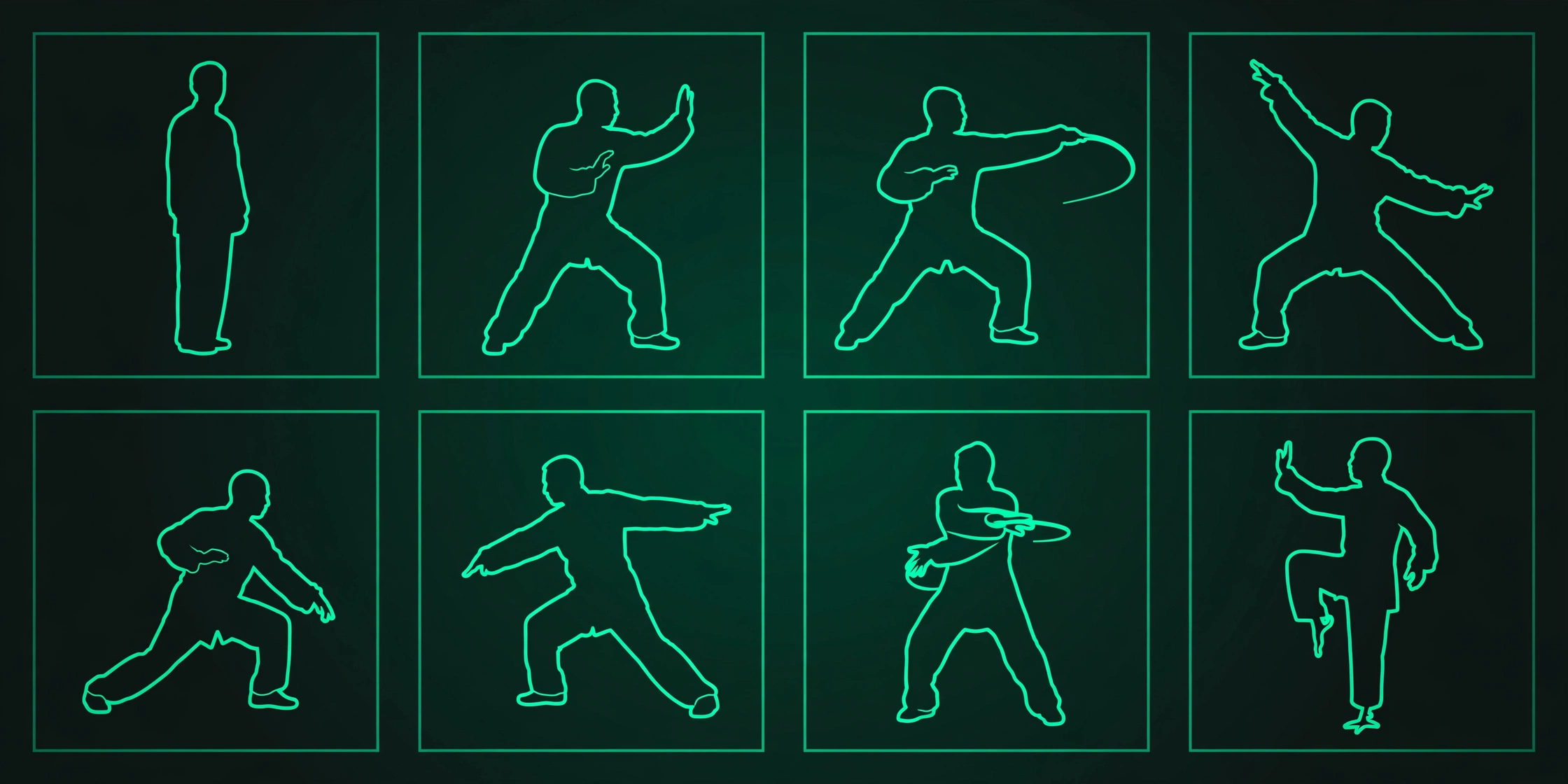
The diagram above shows eight foundational postures. Here's what each one teaches you:
- Commencement — feet rooted, arms rising and falling with the breath. This is where every session begins: stillness before motion.
- Ward Off — one arm arcs like holding a great ball. Teaches you to meet force with structure, not tension.
- Roll Back — the body turns and the arms draw back. You learn to yield and redirect instead of colliding.
- Press — both hands press forward from the center. Pure forward power driven by the legs and hips.
- Push — palms press out as the stance sinks. Full-body extension with a quiet mind.
- Single Whip — one arm extends like a blade, the other hooks back. The most recognizable posture in tai chi — balance in motion.
- White Crane Spreads Its Wings — weight shifts back, arms open wide. Grace, balance, and open hips.
- Brush Knee and Push — one hand brushes past the knee as the other pushes forward. Coordination of upper and lower body in one smooth step.
Don't memorize them — feel them. Ten slow minutes a day beats one rushed hour a week.
Train Tai Chi With a Coach
Tai chi looks simple and hides a hundred details. Alexander teaches it the warrior's way — real stances, real breathing, real progress, paced to your body. Book a session and start your first form, or send a message with your questions.